
Understanding Trusts vs. Wills in Greenwood Village
A Clear Guide for Estate Planning
By Scott Tremlett, Paramount Associates Wealth Management
Navigating the complexities of estate planning can be daunting, especially when deciding between trusts and wills. This guide aims to clarify the distinctions between these two essential legal instruments, helping you make informed decisions about your estate. Trusts and wills serve different purposes in estate planning, each with unique benefits and implications. Understanding these differences is crucial for effective wealth management and ensuring your assets are distributed according to your wishes. In this article, we will explore the key distinctions between wills and trusts, the benefits of using revocable trusts, the role of a fee-based registered investment advisor, and the broader implications for estate planning.
As a foundational concept, estate planning encompasses various strategies for managing and distributing assets after one's passing. Estate Planning: Wills, Trusts, & Asset Distribution
“Estate planning” refers to one’s instructions for the distribution of assets after one’s death, and includes the establishment of a will and/or trusts, and the gifting of property. Estate planning also includes preparing a plan for the care of a child who will need assistance after the parents or other caregivers have died.
Estate Planning, 2021
Key Distinctions Between Wills and Trusts:
Wills and trusts are fundamental components of estate planning, but they function differently. A will is a legal document that outlines how your assets will be distributed upon your death, while a trust is a legal entity that holds assets for the benefit of specific individuals or entities. One of the primary differences is that wills go through probate, a court-supervised process that can be time-consuming and costly. In contrast, trusts typically avoid probate, allowing for a more efficient transfer of assets.
Additionally, trusts can provide privacy since they do not become public record like wills do. This means that the details of your estate remain confidential, which can be a significant advantage for many individuals. Furthermore, trusts can be structured to provide ongoing management of assets for beneficiaries, which is particularly beneficial for minors or individuals who may not be financially responsible. Understanding these distinctions is essential for effective estate planning and ensuring that your wishes are honored.
Benefits of Using Revocable Trusts
Revocable trusts offer several advantages that make them an appealing option for many individuals. One of the primary benefits is the ability to avoid probate, which can save time and money for your heirs. By placing assets in a revocable trust, you ensure that they can be transferred to beneficiaries without the need for court intervention. This streamlined process can significantly reduce the administrative burden on your loved ones during a difficult time.
Indeed, the ability of living trusts to bypass the often-cumbersome probate process is a widely recognized and significant advantage.
Living Trusts: Probate Avoidance & Heir Protection
Much has been written about using the living trust to avoid probate. One would assume from the information out there that probate avoidance is the most important value of having a trust
Living Trusts for Everyone: Why a Will is Not the Way to Avoid Probate, Protect Heirs, and Settle Estates, 2017
Another key benefit of revocable trusts is the privacy they provide. Unlike wills, which become public documents upon death, trusts remain confidential. This means that the details of your estate and the distribution of your assets are not disclosed to the public, protecting your family's privacy. Additionally, revocable trusts offer flexibility, allowing you to modify the terms or revoke the trust entirely as your circumstances change.
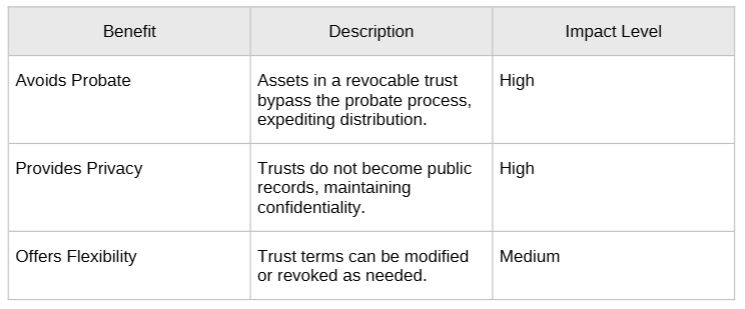
These benefits make revocable trusts a powerful tool in estate planning, allowing for greater control and peace of mind.
Role of a Fee-Based Registered Investment Advisor
Working with a fee-based registered investment advisor (RIA) can enhance your estate planning process significantly. These professionals adhere to a fiduciary duty, meaning they are legally obligated to act in your best interest. This alignment of interests ensures that you receive unbiased advice tailored to your financial situation and goals. A fee-based RIA typically charges transparent advisory fees rather than commissions, which can lead to more objective recommendations.
Moreover, a fee-based RIA can coordinate with estate attorneys to create a comprehensive estate plan that includes both trusts and wills. Their expertise in financial planning allows them to provide a holistic approach, considering your entire financial picture when developing your estate strategy. This collaboration can help you navigate the complexities of estate planning, ensuring that your assets are managed effectively and your wishes are fulfilled.
Paramount Associates, a fee-based registered investment advisor operating in the Denver Metro area, emphasizes fiduciary-aligned wealth management. They offer estate planning education, including trusts and wills, through dedicated services such as estate, charitable giving, and trust planning. Their planning-first philosophy and commitment to transparency make them a valuable resource for individuals seeking to optimize their estate plans. Implications for Estate Planning
The implications of choosing between a will and a trust extend beyond mere asset distribution.
Understanding the complexities of estate planning is crucial for ensuring that your wishes are
honored and your loved ones are protected. Proactive planning can help mitigate potential
disputes among heirs and reduce the likelihood of lengthy probate processes. Additionally,
considering the tax implications of your estate plan is essential, as different strategies can
impact your beneficiaries' financial outcomes.
As you navigate your estate planning journey, it is vital to consult with professionals who can
provide guidance tailored to your unique circumstances. Engaging with a fee-based registered
investment advisor can help you develop a comprehensive strategy that aligns with your
financial goals and family dynamics.
To further enhance your financial strategy, consider exploring financial planning options. This
can provide a more holistic approach to managing your assets and securing your future.
For businesses looking to secure their future, business planning is essential. It ensures long-
term stability and growth.